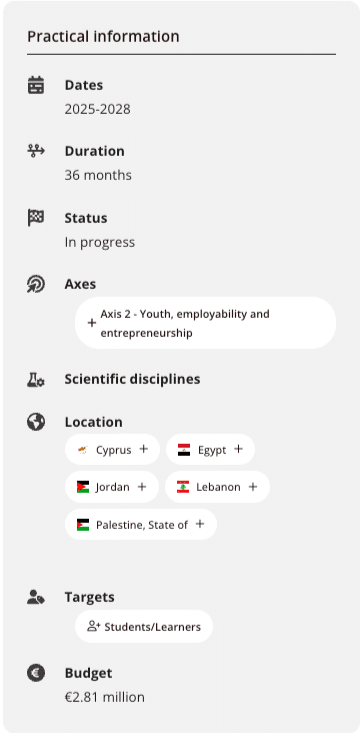

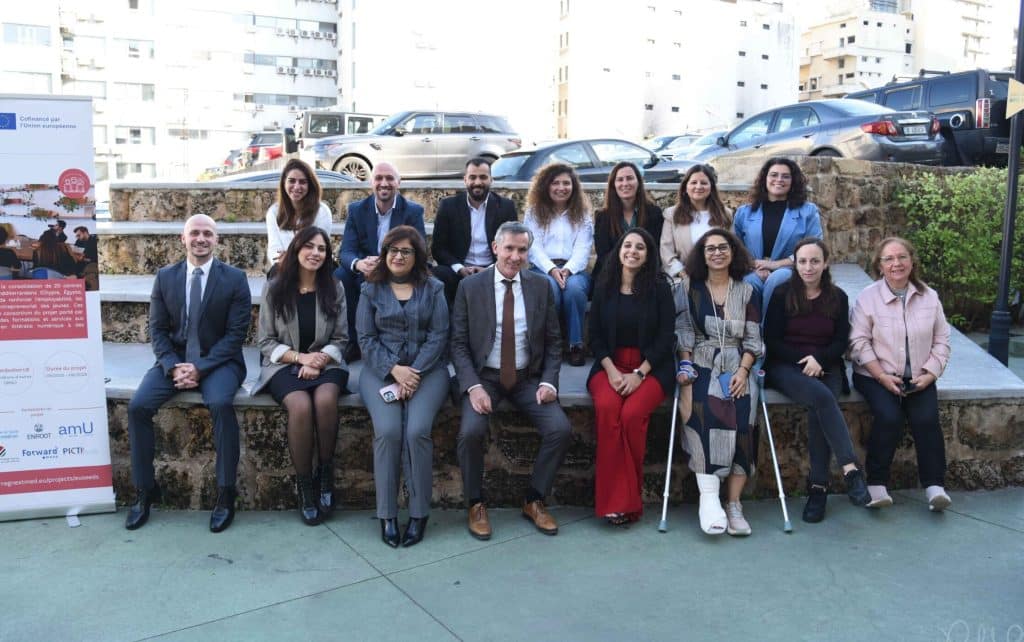
AUF Middle East is the lead partner of the EUSEEDS project, co-financed by the European Union under the Interreg NEXT MED Programme, to the tune of nearly €2.5 million, out of a total of nearly €2.8 million.
The project is implemented by a balanced consortium of 7 partners spread across 6 countries, with 4 regional partners ( Enroot in Egypt; Jordan Youth Innovation Forum in Jordan; Forward Mena in Lebanon; Palestine Information and Communication Technology Incubator in Palestine) and 2 European partners ( Center for Social Innovation in Cyprus and Aix-Marseille University in France).
With an average unemployment rate of 40.5% among young graduates, the non-EU countries where the project is being deployed face a huge common challenge that the project intends to help partially address by developing non-sectoral skills that are very little acquired but essential for professional integration, employability, digital skills and entrepreneurship.
The EUSEEDS project aims to deploy 20 university centers in five countries of the Eastern Mediterranean (Cyprus, Egypt, Jordan, Lebanon and Palestine) in order to strengthen the employability and digital skills of young people.
These resource centers, located in areas with significant social challenges, will be equipped and staffed with the necessary skills to sustainably carry out two types of missions:
The project aims to improve young people’s access to employment by providing them with digital and transferable skills tailored to the labor market, as well as support for self-employment. It will enable the large-scale development of training capacities, the pre-incubation of student projects, and the strengthening of the sharing of experiences, know-how, and transnational cooperation between organizations.
The project aims to produce massive effects, with short, medium and long-term impacts.
At the end of the project:
The project aims to produce massive effects, with short, medium and long-term impacts.
At the end of the project: